


Starkey Omega AI+ Hearing Aid Review (2026)

Hearing Aid Specialist

Brad Ingrao
Editor & Doctor of Audiology
Starkey is moving fast. Very fast.
In October 2025, the Minnesota-based manufacturer launched the original Omega AI, bringing its DNN 360 system, exceptionally long battery life, and a long list of AI-powered features into its flagship hearing aids. Less than a year later, Starkey is back with Omega AI+.
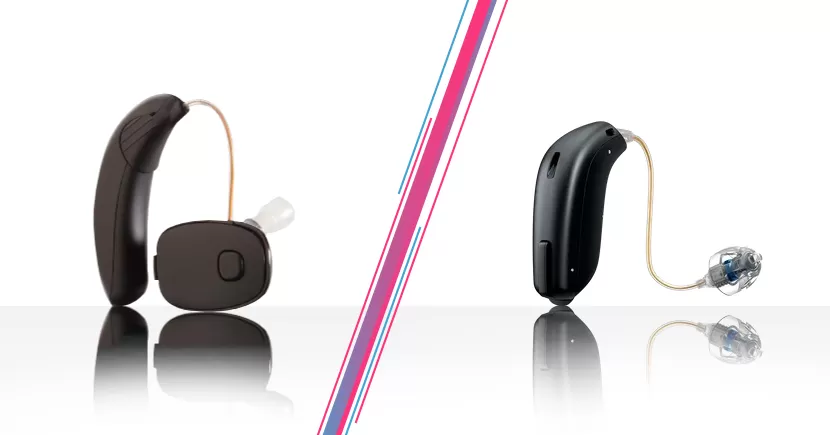
At a high level, Starkey Omega AI+ is available in a broad range of styles, including traditional receiver-in-canal models, rechargeable RICs, a size-312 battery option, and several custom in-the-ear configurations ranging from larger rechargeable ITE/ITC models down to tiny CIC and IIC designs.The entire Omega AI+ lineup is available in 24, 20, and 16 technology levels; the only exception is the tiny non-wireless IIC, which is offered exclusively in the premium 24 level.
Wireless models support Bluetooth Low Energy Audio and Auracast, giving you direct streaming from compatible phones and access to Starkey’s StarLink accessories, while rechargeable models offer all-day battery life—with the flagship RIC RT rated for up to 51 hours per charge.

So, whether your priority is maximum connectivity, a rechargeable design, a discreet custom fit, or simply choosing the right technology level for your lifestyle and budget, there’s a lot of flexibility within the Omega AI+ family.
In all honesty, a lot of the above was available in the original Starkey Omega AI, and the shell/casing of the hearing aids haven’t changed, so you could be forgiven for wondering what the “+” actually gets you. But underneath the hood, quite a bit has changed.
What’s New With Starkey Omega AI+?
Omega AI+ looks identical to the original Omega AI.
The important upgrades are happening inside the hearing aid. Omega AI+ is built around Starkey’s new G4 Gen AI Neuro Processor, which provides the horsepower for a new Quad DNN Architecture—essentially four specialized deep neural networks working together to handle different parts of the listening experience.
That new architecture powers what Starkey calls the world’s first DNN Dual Compressor, along with an improved version of Edge Mode that can now remain active continuously on the premium Omega AI+ 24. Starkey has also redesigned its feedback management, expanded Auracast support across its wireless lineup, and brought more of its advanced AI processing into custom in-the-ear hearing aids.
And because apparently hearing aids aren’t content with just helping you hear anymore, Omega AI+ can even track your sleep—assuming you’re willing to wear your hearing aids to bed.
There’s a lot packed into that list. But I think the most important place to start is with the new processor and the way Starkey is using deep neural networks differently this time around.
A New G4 Gen AI Neuro Processor
The G4 Gen AI Neuro Processor is the new “brain” inside Omega AI+.
Starkey says it processes sound up to 2.7 times faster than other leading hearing aids marketed with DNN processing. I’d take any manufacturer-versus-competitor benchmark with the appropriate grain of salt, but faster processing does matter.
A hearing aid is constantly analyzing incoming sound, deciding what should be amplified, what should be reduced, where speech is coming from, and how aggressively it should react. The faster it can make those decisions, the more naturally all of that processing can happen in real time.
But the more interesting story isn’t simply that Starkey built a faster chip.
It’s what they’re doing with it.

Instead of relying on one deep neural network, Omega AI+ uses four specialized DNNs working simultaneously. Starkey calls this its Quad DNN Architecture. Collectively, these neural networks help manage directionality, spatial awareness, difficult listening environments, and now one of the most fundamental parts of hearing aid processing: compression.
And that brings us to what I think may be the most interesting new feature in Omega AI+.
Quad DNN Architecture and DNN Dual Compressor
Every hearing aid has to solve a strange problem.
If you have hearing loss, soft sounds need to be made louder—but loud sounds usually don't need the same amount of amplification. Hearing aids therefore use something called compression to squeeze the enormous range of sounds in the world into the smaller usable hearing range of someone with hearing loss.
Think of compression as an extremely fast, automatic volume control.
Historically, engineers have had to choose how quickly that volume control should react.
Fast compression can quickly bring out short speech sounds, particularly consonants. But react too aggressively and the hearing aid can start manipulating everything around you, sometimes creating a noticeable pumping or fluctuating quality.
Slow compression tends to sound smoother and more natural, but it may not react quickly enough to squeeze every useful speech cue into your remaining hearing range.
There’s the tradeoff.
Omega AI+ tries to have both.
Its new DNN Dual Compressor uses neural-network processing to determine when fast compression makes sense for speech and when slower compression should be preserved for sound quality. Starkey’s professional materials say users in its testing noticed fewer processing artifacts compared with the previous technology.
This may turn out to be one of the more consequential improvements in Omega AI+, even though it is considerably less marketable than simply shouting “AI!” from the rooftops.
Why?
Because compression is working all day, every day. You don't need to open an app or activate a special restaurant program to benefit from it.
If Starkey has genuinely improved the balance between audibility, clarity and naturalness, you could hear that difference while talking at the kitchen table, walking through the grocery store, typing at your computer, or sitting in a quiet room—not just when someone starts clattering plates behind you at a restaurant.
DNN 360, Edge Mode and Hearing in Noise
The other pieces of Starkey’s AI strategy will be more familiar to anyone who followed the original Omega AI.
Omega AI introduced DNN 360, combining neural-network-powered directionality with spatial-awareness processing. The idea is to improve speech without turning your hearing aids into a pair of acoustic horse blinders.
Traditional directional systems are very good at saying, essentially, “The person in front of you is important. Reduce everything else.”
That works beautifully until your spouse says something from beside you, a waiter approaches from behind, or you start walking around.
Starkey’s approach considers the sound environment along with information from the hearing aids’ motion sensors. If you’re sitting still and talking to someone across a restaurant table, the hearing aid can behave differently than when you’re walking down a sidewalk and need broader awareness of your surroundings.
With Omega AI+, Starkey is also making Edge Mode more flexible.
Edge Mode has traditionally been Starkey’s “I need help right now” button. When you encounter a particularly difficult environment, you activate it and the hearing aid analyzes the situation, then gives you additional speech or noise-management help.
The neural network behind it has now been retrained, and on the premium Omega AI+ 24, Edge Mode can remain active continuously and adapt as the environment changes rather than requiring repeated activation.
That sounds like a small usability change. I don't think it is.
In practice, most hearing aid wearers don’t want six programs and a laminated instruction card explaining which one to use at Thanksgiving dinner. The closer we get to one really good automatic program—with an AI system continuously making intelligent decisions behind the scenes—the better.

Starkey has also redesigned its feedback-management system. According to Starkey's internal testing, Omega AI+ increased available gain before feedback by 21 dB at mid frequencies and 11 dB overall, while reducing feedback artifacts by 32 dB.
Translated into English: the hearing aids should be able to provide more amplification before they whistle.
That can be particularly important for people with greater hearing loss and for fittings where we want a little more venting in the ear to make your own voice sound less plugged-up.
Again, these are manufacturer tests. Independent lab testing and broader customer experience will tell us more over time.
My Starkey App and Health Features
Starkey has spent the last several generations turning the hearing aid into something closer to a wearable computer, and Omega AI+ continues that trend.
Wireless models support Bluetooth Low Energy Audio and Auracast, and work with Starkey's StarLink Edge TV Streamer, remote microphones and table microphone. Auracast is particularly interesting because it is designed to let compatible hearing aids receive public broadcasts directly—think airports, theaters, houses of worship, conference rooms and TVs.
The My Starkey app handles the usual volume and program adjustments, but also includes considerably more ambitious features: Translate, Transcribe, a Gen AI Smart Assistant, TeleHear AI, Find My Hearing Aids, hearing/activity tracking, fall alerts, balance tools and remote fitting capabilities.
And now we get to perhaps the strangest new Omega AI+ feature: sleep tracking.
Using sensors inside the hearing aids, Omega AI+ can generate sleep scores and track information such as sleep cycles and body position. There is, of course, one fairly important catch:
You have to sleep with your hearing aids in.

For most people, hearing aids are the first thing coming out before their head hits the pillow. But there are people—particularly those with more significant hearing loss—who prefer wearing their aids at night so they can hear an alarm, a knock at the door, or another person in the house.
For that group, the feature makes more sense.
Starkey is careful to say this isn't a diagnostic or screening tool for sleep apnea or other sleep disorders. Think of it as wellness information, not a medical test. Omega AI+ also adds a “hearing aid left behind” alert, which may prove considerably more useful to considerably more people.
My Early Take on Starkey Omega AI+
There are three things that really stand out to me with Omega AI+.
First, specialized DNNs are clearly becoming the direction hearing aid technology is heading, and frankly, it makes a lot of sense. Rather than asking one neural network to be great at everything, manufacturers can build different DNNs for different jobs—speech, directionality, spatial awareness, compression, and so on. We’re seeing a similar idea play out in the broader AI world, where certain models are better at coding, others at writing, others at reasoning. Omega AI+ takes that same general approach with its Quad DNN Architecture, and I suspect we’re going to see a lot more of this across the hearing aid industry over the next few years.
Second, I love what Starkey continues to do with features like sleep tracking. Will everybody wear their hearing aids to bed and obsess over their sleep score? Absolutely not. But that almost misses the point. Starkey has been unusually willing to experiment with what a hearing aid can be beyond simply an amplifier. Fall detection, activity tracking, balance tools, and now sleep tracking—it feels like they’re constantly throwing thoughtful ideas at the wall and seeing what actually becomes useful to patients. Some of those features will stick, some probably won’t, but I like that Starkey keeps pushing the boundaries of what people should expect from a device they already wear for most of the day.
And then there’s always-on Edge Mode, which might be my favorite practical improvement in this release. When Starkey first introduced Edge Mode with Edge AI, one of our complaints was that it worked really well—but you had to deliberately activate it when you needed it. That always felt a little backwards. If the hearing aid is smart enough to analyze a difficult listening environment and improve it, why should the wearer have to tell it when to start? Omega AI+ 24 finally addresses that. Edge Mode can now remain active and continuously adapt as your surroundings change. And because Edge Mode has historically worked very, very well, giving it the ability to essentially stay on in the background is a meaningful upgrade—not just another feature for the brochure.
Put all of that together, and Omega AI+ feels less like Starkey chasing one giant headline feature and more like the company refining its overall philosophy: more specialized AI running automatically, with less effort required from the person wearing the hearing aids. To me, that’s exactly where hearing aid technology should be going.
Hearing Aid Specialist
Brad Ingrao
Editor & Doctor of Audiology

->getDescriptorURL()?>)






![Preview for the "Phonak Hearing Aid Models & Prices [2026 Version]" video](https://cdn.ziphearing.com/dist/dynamic/files/videos/365/thumbnail/version/1/1200/thumbnail.avif "Phonak Hearing Aid Models & Prices [2026 Version]")

![Preview for the "Oticon Hearing Aids Models and Prices [2026 Version]" video](https://cdn.ziphearing.com/dist/dynamic/files/videos/400/thumbnail/version/1/1200/thumbnail.avif "Oticon Hearing Aids Models and Prices [2026 Version]")